Old Plumbing in Toronto Century Homes
Galvanized, Cast Iron, Copper & Lead
Century homes rarely have one plumbing system.
They’ve usually been renovated gradually, which means you might find 100-year-old cast iron beside 50-year-old copper beside brand-new PEX in the same basement.
That’s normal.
The important question isn’t whether some plumbing has been updated.
It’s what remains.
Start in the basement
An unfinished basement can tell you a lot.
Follow the visible water and drain lines and look for changes in material.
A house advertised as having “updated plumbing” may indeed have new plumbing in a renovated kitchen or bathroom while older supply or drain lines remain elsewhere.
That’s not necessarily misleading. It’s simply how houses evolve over 100 years.
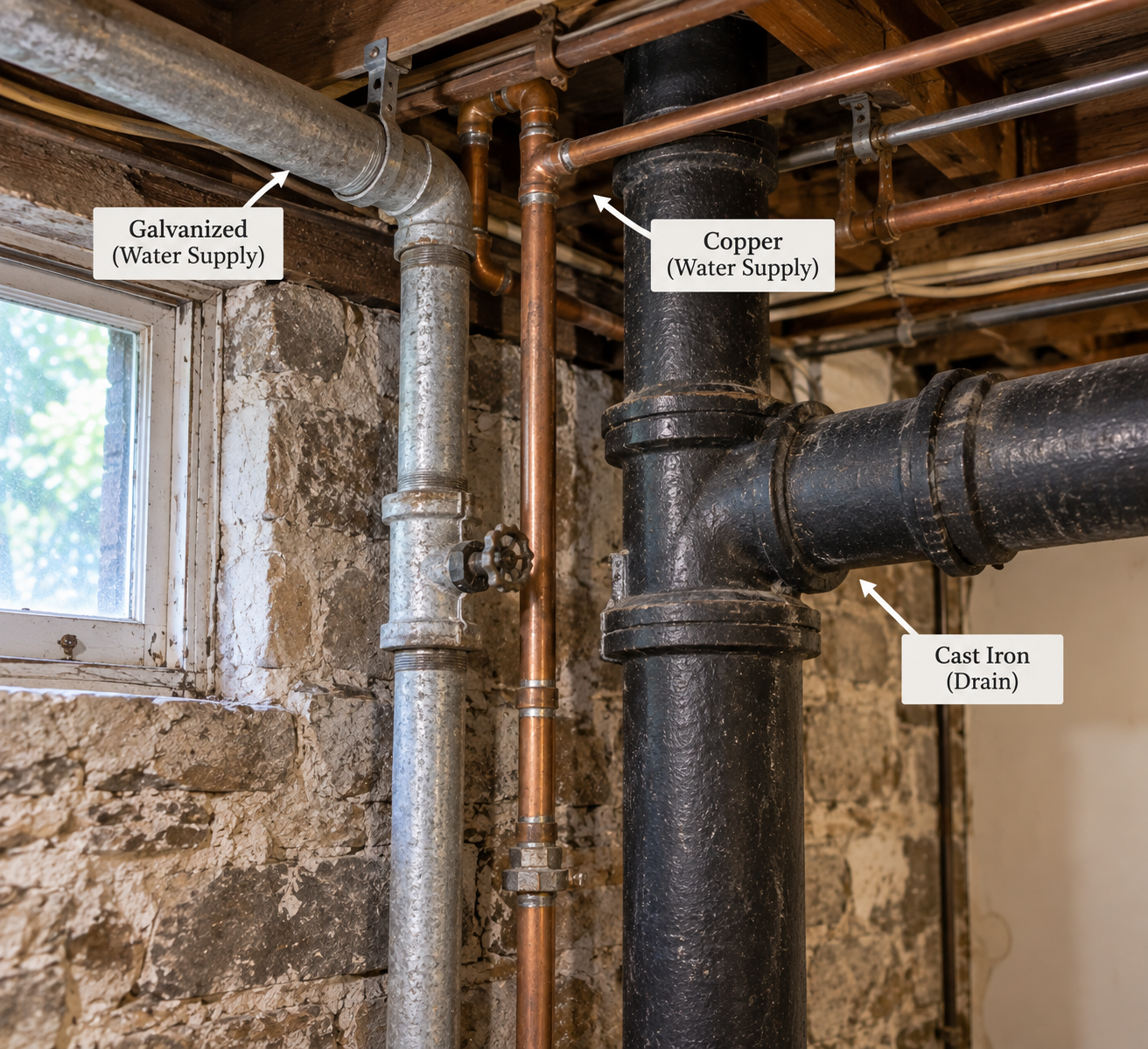
Galvanized steel water lines
Galvanized plumbing is usually grey or silver metal with threaded fittings.
The concern isn’t simply that it’s old.
Galvanized pipes can corrode internally over time, gradually reducing the inside diameter of the pipe.
That can eventually mean lower water pressure and restricted flow, even when the outside of the pipe doesn’t look particularly alarming.
If I see galvanized supply lines, I want to know how much remains, and I’d want to replace them.
Cast-iron drains
Cast iron is commonly found in older drain and waste systems.
It’s heavy, dark and usually much larger in diameter than the water supply pipes.
And importantly:
Cast iron isn’t automatically bad.
Some older cast-iron drains continue functioning perfectly well.
What I’d look for is corrosion, leaking joints, cracking or sections that appear significantly deteriorated.
Copper plumbing
Copper usually tells you that at least part of the plumbing system has been updated.
It’s easy to recognize by its familiar copper colour, although older pipe will darken with age.
Copper itself is generally a positive thing to find.
But again, follow it.
A newer copper line may eventually connect to an older material elsewhere in the house.
Seeing copper beside the water heater doesn’t necessarily tell you what supplies the third-floor bathroom.
What about PEX?
PEX is flexible plastic water-supply tubing commonly used in newer renovations.
Finding PEX usually indicates relatively recent plumbing work.
As with copper, though, I’d still want to understand how much of the house was actually updated.
A renovated bathroom can have completely new plumbing without the rest of the house being replumbed.
Lead deserves special attention
Lead is different because it raises a drinking-water concern.
In Toronto, older properties may still have lead water service pipes.
And importantly, the pipe you see inside the house is only part of the story.
Toronto water service pipes are divided between a private portion owned by the property owner and a City-owned portion. Either portion may potentially have been replaced at a different time.
If there’s a possibility of a lead service, I’d want to investigate rather than assume it has been replaced because some interior plumbing is new.
Check the water pressure
This is one of the easiest things to do during a showing.
Turn on a faucet.
Then try another one.
If running two fixtures causes the water flow to drop dramatically, that deserves further investigation.
It doesn’t diagnose the problem, but it can give you a clue that older supply plumbing may be restricting flow.
What about Kitec plumbing?
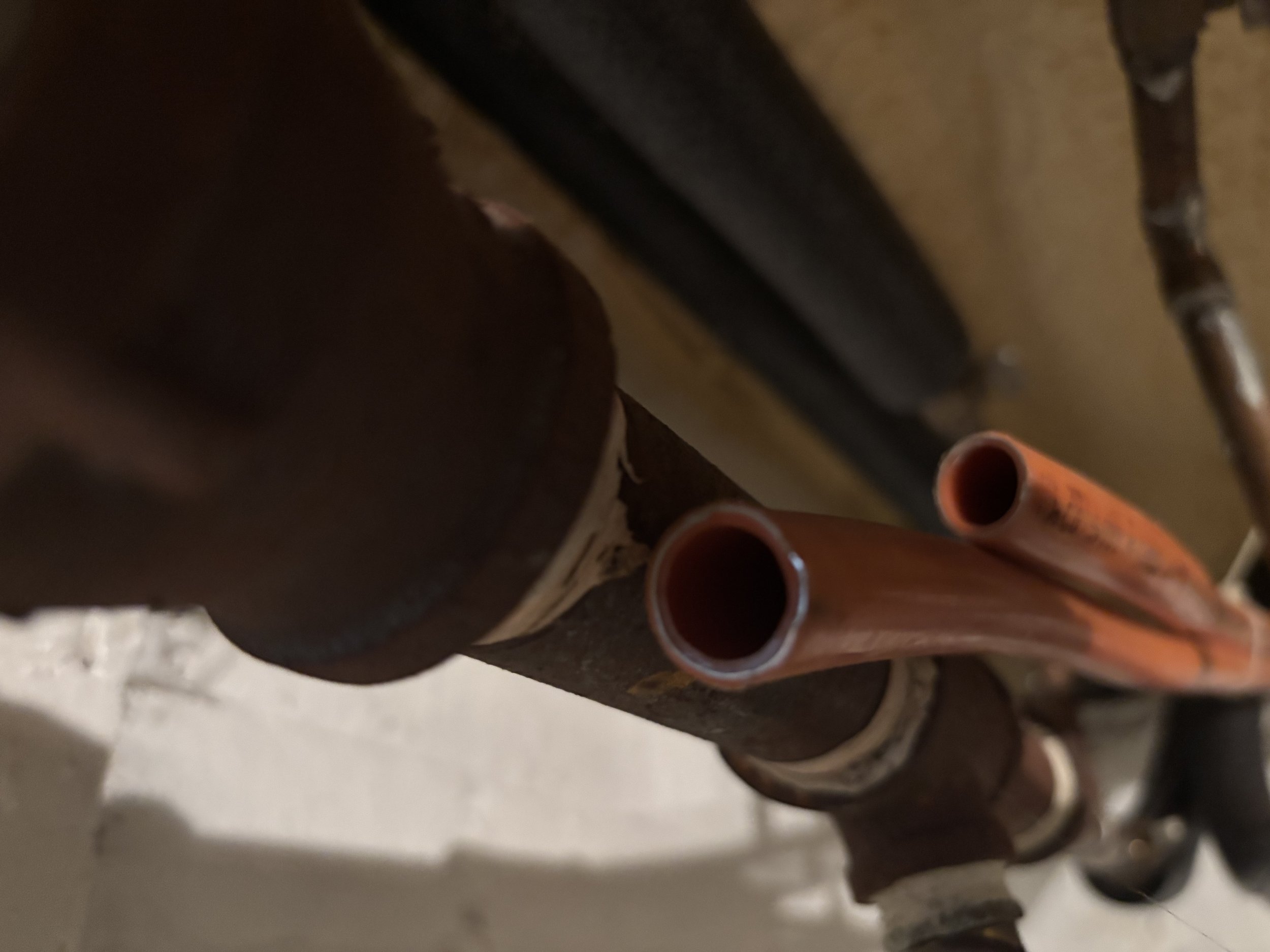
Kitec is a type of flexible plumbing that was installed in many Canadian homes from the mid-1990s into the 2000s.
So unlike galvanized or cast iron, Kitec isn’t a century-home material. You may encounter it because the older house was renovated during that period.
Kitec tubing is often orange on hot-water lines and blue on cold-water lines, although colour alone shouldn’t be used to identify it. Look for markings such as Kitec, KITEC, IPEX, AQUA or XPA printed on the pipe, along with characteristic brass fittings.
Kitec has a history of premature failures involving both the pipe and fittings and is no longer manufactured.
If I find it in a Toronto house, I want to know how much remains and where it goes.
This is particularly important with renovations. You might see modern plumbing in an unfinished basement but discover Kitec supplying a renovated bathroom, kitchen or hydronic floor-heating system elsewhere in the house.
And that’s an important distinction: Kitec can also be used in heating systems, not just at faucets.
Finding Kitec doesn’t tell you that a leak is imminent. But it is something I’d identify before buying, discuss with the insurer, and have appropriately assessed so you understand the extent and potential cost of replacement.
Does old plumbing mean the house needs to be replumbed?
Not necessarily.
I’d want to know:
Which materials are present? How much of each remains? Are there active leaks? Is water pressure good? Are drains functioning properly? And is there any lead in the water service?
That’s far more useful than simply asking whether the house has “updated plumbing.”
With a century home, updated rarely means everything was replaced at once.
The trick is figuring out what was done—and what’s still original.
Mike Perkins
Toronto Real Estate Agent
Real Estate. Thoughtfully Advised.
I work with buyers and sellers of older and character homes throughout Toronto. With century homes, I like to follow the systems rather than rely on broad descriptions such as “updated electrical” or “updated plumbing.” The details usually tell you much more.